
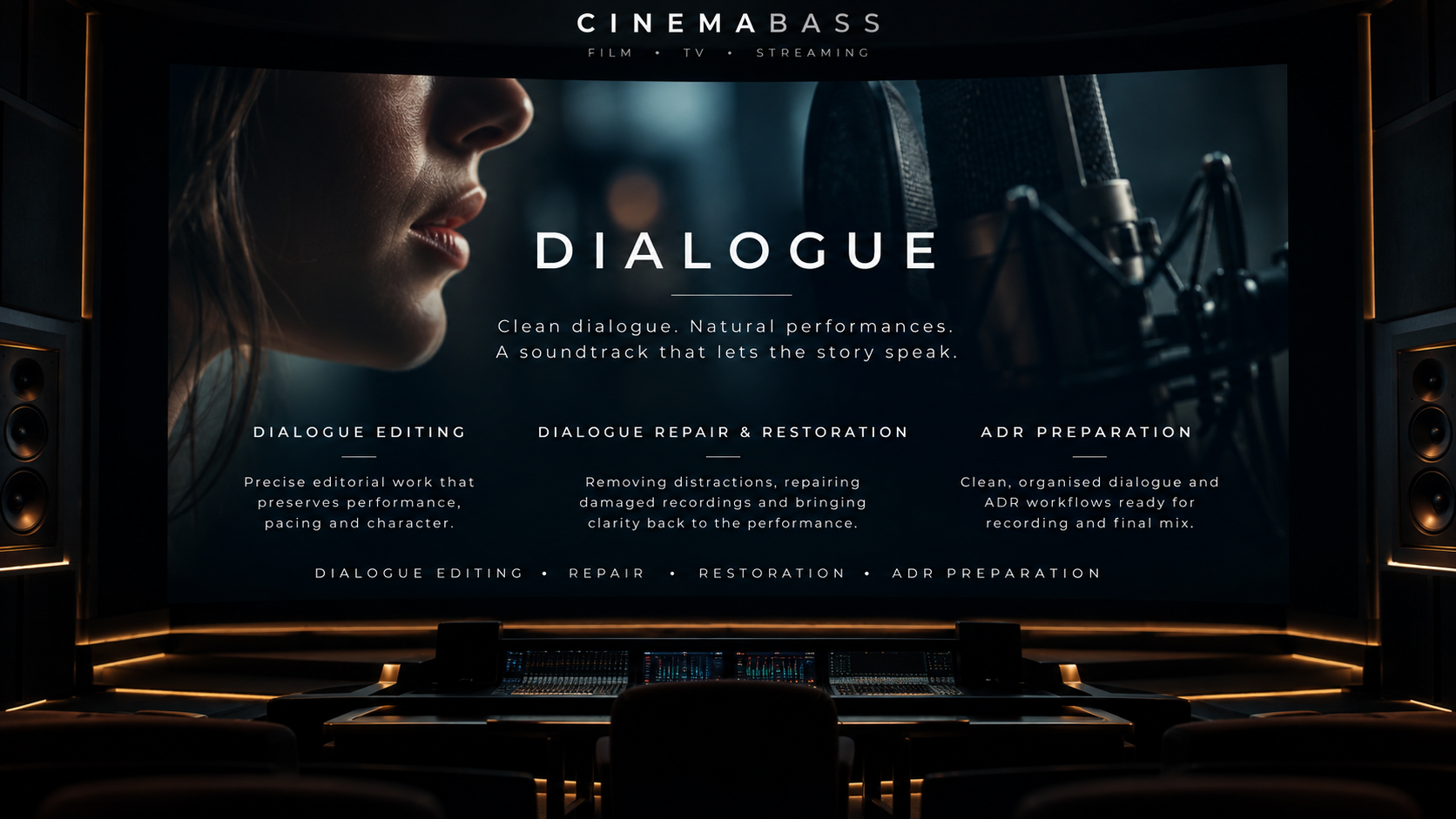
DIALOGUE
Great dialogue should feel effortless.
The audience should hear the performance, the emotion and the story — without being distracted by the recording itself.
Dialogue is often the foundation of a film's soundtrack. When it works, everything else can be built around it. When it doesn't, even a powerful scene can lose its impact.
My approach is to work carefully with the original production recordings, preserving the character, timing and performance while bringing the dialogue to a level where it can sit naturally within the finished soundtrack.
DIALOGUE EDITING
Every production recording brings its own challenges.
I work through production dialogue carefully, selecting the strongest takes, cleaning unwanted noise, managing edits and matching recordings so that the dialogue flows naturally from one shot to the next.
The goal isn't to make the dialogue sound processed or artificial.
It's to make the edit disappear.
REPAIR & RESTORATION
Not every recording arrives in perfect condition.
Background noise, room tone, microphone movement, clothing noise, wind, interference, distortion and difficult production environments can all become part of the challenge.
Where possible, I work to recover and restore the original recording while retaining as much of the natural performance as possible.
Sometimes the solution is subtle.
Sometimes it requires considerably more work.
The objective remains the same — preserve the performance and make the recording work for the film.
PREPARING THE SOUNDTRACK
Dialogue doesn't exist in isolation.
Once the dialogue has been edited and prepared, it needs to work alongside Foley, sound effects, sound design and music. Levels, transitions, room tone and perspective all contribute to how naturally the dialogue sits within the scene.
Careful dialogue preparation at this stage gives the re-recording mix a clean and flexible foundation to work from.
And when ADR is required, the same principle applies: the replacement should feel like it was always part of the performance.
THE CINEMABASS APPROACH
I don't believe dialogue should simply be made louder, cleaner or more intelligible.
It should belong to the scene.
The best dialogue work is often the work the audience never notices — because they're listening to the character rather than listening to the edit.
Preserve the performance.
Respect the recording.
Serve the story.
That's the job of dialogue.